
Why most ESL pilots underdeliver
The pattern repeats: a chain commits to “let’s pilot ESLs,” buys 2,000 labels, deploys them across multiple departments in a single weekend, and three months later concludes “ESLs aren’t working for us.”
The technology was fine. The pilot was wrong. Specifically:
- Too many SKUs at once — couldn’t isolate workflow problems
- No baseline metrics — couldn’t prove savings
- No staff buy-in — clerks resisted because they weren’t consulted
- No clear “go/no-go” criteria for expansion
This playbook avoids those failure modes.
Phase 1: Pick the right pilot scope (Week 1)
Pick ONE department in ONE store. Specifically:
The right department
Choose the department with: (a) frequent price changes, (b) high SKU velocity, (c) clear shelf layout (not too many endcaps).
- Best: Dairy aisle (high turnover, dynamic pricing)
- Good: Frozen foods (freezer-rated test, focused SKU set)
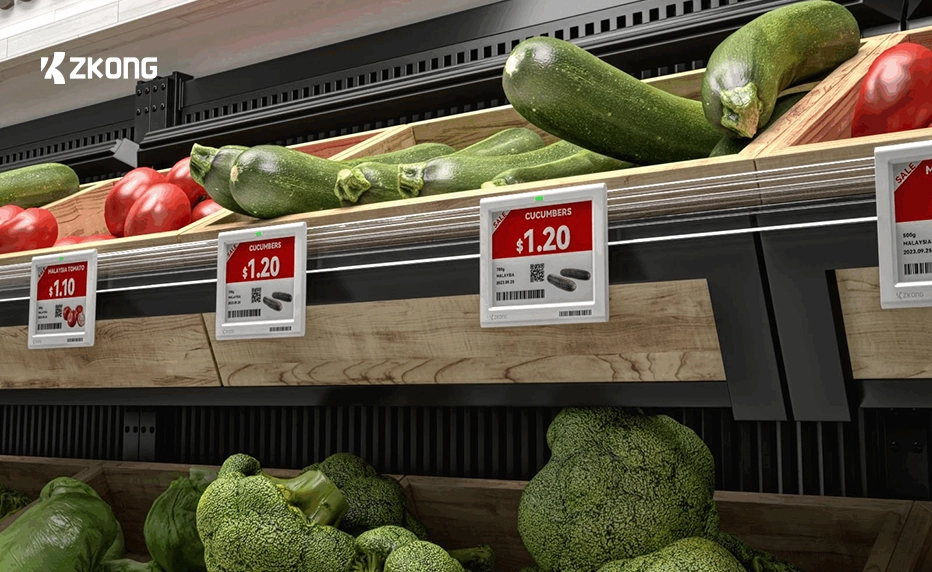
- Good: Produce (price-by-weight, daily markdown)
- Avoid: Center-store grocery (slow-changing, less dramatic ROI)
- Avoid: Liquor (regulated pricing complications)
The right store
Pick a busy store, not your slowest. You want real operational stress to expose any workflow gaps.
The right SKU count
200-500 labels for the pilot department. Enough to be statistically meaningful, small enough to debug.

Phase 2: Establish baseline metrics (Week 2)
Before you install a single label, measure:
- Time spent on daily price updates in this department (have a clerk track for 1 week)
- Number of price errors caught at POS (week-by-week trailing 4 weeks)
- Customer service complaints related to shelf-vs-checkout pricing
- Labor cost: hourly rate × hours/week × 52 = annual baseline
- Paper supplies cost: printer rolls, ink, label stock used per week × 52
Have someone NOT involved in the project measure this. You want unbiased baseline numbers to compare against later.
Phase 3: Install + train (Week 3)
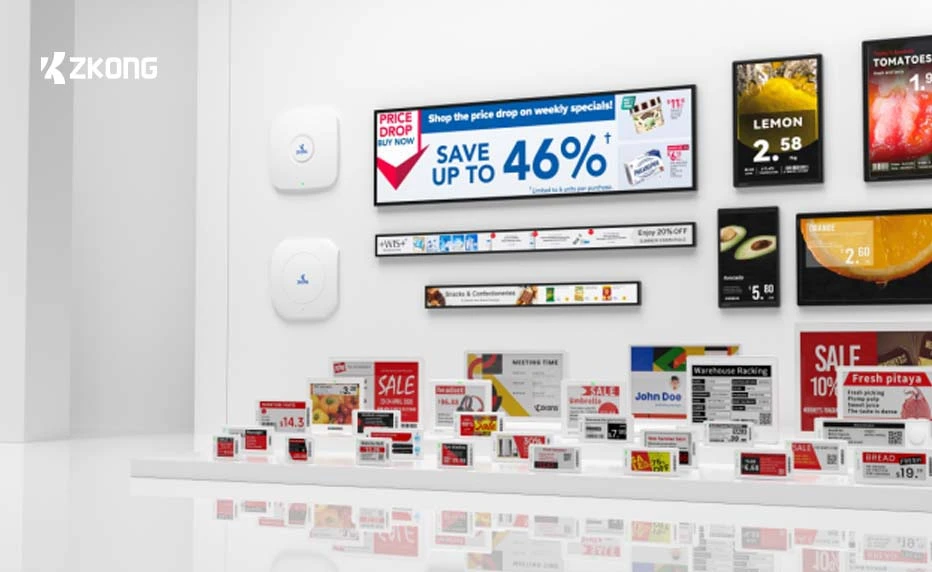
Order ESLs (200-500 for pilot dept). For most groceries, the right starting SKU mix is:
- Valley Series (1.5″-2.6″) for standard shelf labels
- Shield Series freezer variants for cold sections
- Arrow Series if you want to test shelf-edge bars on multi-product strips
Install (1-2 days)
Two staff can install 200-500 labels in one shift. Most ESLs ship with adhesive or rail-clip mounts. Install access points on the ceiling (1 per ~200 labels). Connect to your network.
Configure (1 day)
Map each label to its SKU in the cloud platform. Most platforms have a phone app for label-by-label assignment via NFC tap.
Train staff (4 hours total)
2 hours: floor staff on what ESLs are, how to flag a broken label, what NOT to do (don’t remove, don’t replace battery yourself).
2 hours: department manager on the cloud platform — how to push price updates, view audit logs, troubleshoot.

Phase 4: Run for 4 weeks, measure obsessively (Weeks 4-7)
Track the same metrics as your baseline:
- Time spent on daily price updates (now: should be near-zero)
- Price errors caught at POS for these SKUs (should drop to zero)
- Customer complaints (should drop to zero)
- Battery failures (should be zero — labels are new)
- Network reliability (should be 99%+ uptime)
Also track operational issues:
- Did clerks find any labels confusing or hard to read?
- Were there any SKUs that needed special handling?
- Did the cloud platform integrate cleanly with your ERP?
- Any Wifi / network gaps in the store?
Phase 5: Go/no-go decision (Week 8)
The decision criteria for chain-wide expansion:
GO if:
- Labor savings >15 hrs/week per pilot department
- Zero price errors caught at POS for pilot SKUs
- Battery failure rate <0.1% in pilot period
- Floor staff report neutral-to-positive (not actively resisting)
- ERP integration is stable
PAUSE and iterate if:
- Labor savings <5 hrs/week (your dept may not have been the right pilot)
- Network reliability <95%
- Floor staff actively avoiding (workflow needs redesign)
- Cloud platform crashed more than once
NO-GO if:
- ERP integration fundamentally broken
- Battery failures >1% in 8 weeks (vendor problem)
- Multiple labels physically broken (vendor problem)
If GO: deploy chain-wide, store-by-store, on a 4-6 week per-store cadence. Use the playbook from your pilot.
Talk to us if you want help scoping a pilot specific to your store layout. We’ve helped multiple chains start with one department and expand from there.
Want a personalized recommendation?
15 minutes on a screen-share — we look at your specific stores and recommend SKUs.