

The single most expensive paper-label moment in modern US restaurant history was probably a 2023 enforcement action where a 38-location regional chain was assessed approximately $112,000 in FDA penalties because their menu boards in seven locations still showed pre-reformulation calorie counts that were 80 to 240 calories below the new values, eleven months after the reformulation took effect. The compliance lag was not a software problem or a data problem. It was a printing-and-shipping problem: the chain had updated the menu nationwide, ordered new printed boards, and seven of the locations were still working through old inventory. That is the failure mode digital menu boards and ESLs solve.
What 21 CFR 101.11 Actually Requires
The FDA’s calorie disclosure rule, codified at 21 CFR 101.11 and effective May 2018, applies to restaurants and similar retail food establishments that are part of a chain of 20 or more locations doing business under the same name with substantially the same menu items. The rule requires that calorie counts be displayed clearly and conspicuously on menus and menu boards at the point of order, in a font no smaller than the name or price of the menu item, with the statement “2,000 calories a day is used for general nutrition advice, but calorie needs vary” displayed prominently.
The compliance burden is not the math (the math is FDA-acceptable using nutrient databases, lab analysis, or recipe calculation) but the propagation. When a chain reformulates a recipe — say, switches to a different cheese supplier and the calorie count on the cheeseburger drops by 40 — the menu board change has to land at every covered location. The FDA does not care how many locations you have; it cares whether each one is correct.
The Manual Paper Process and Why It Breaks
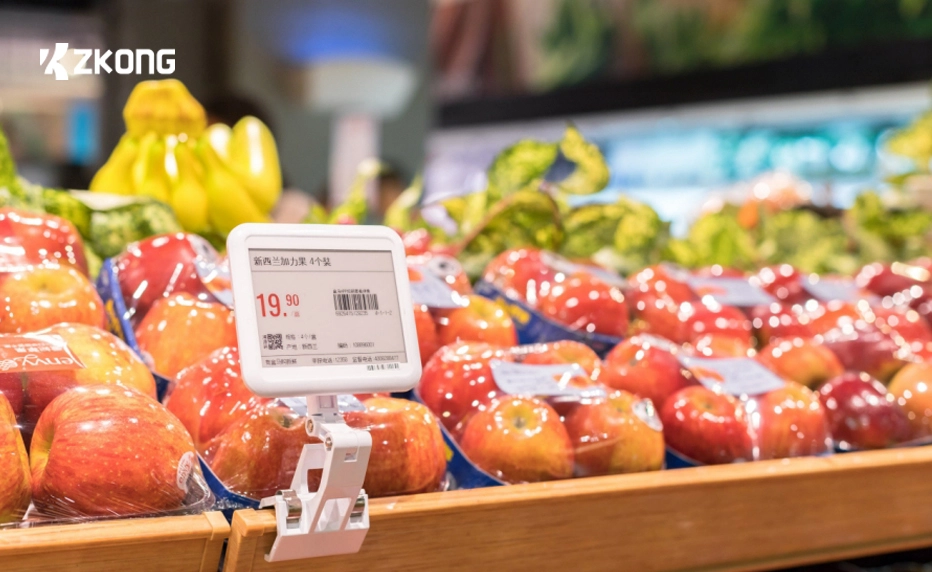
The traditional process at a 200-location chain looks like this: corporate menu engineering finalizes a reformulation, the marketing team updates the printed menu artwork, a print run is ordered (lead time 7 to 14 days), the inserts ship to locations (3 to 7 days), and the locations swap them on a designated date. Best case, the cycle is 14 days. Real case, when print runs require revision or distribution gets uneven, is 30 to 90 days. Drive-thru menu boards are worse, because they are usually backlit translucent panels that require a per-board print and physical replacement.
During the 30 to 90 day window, the chain is technically out of compliance at every location that has not yet swapped. The 2023 enforcement case above turned on locations that were eleven months behind because the operator did not order replacement panels for the old format until inventory ran out.
The ESL and Digital Menu Board Solution
Digital menu boards (LCD or e-paper at larger sizes) and ESLs (e-paper at smaller sizes) collapse the propagation cycle from weeks to seconds. The reformulated calorie count gets pushed from the menu management platform to every covered location simultaneously. The fastest deployments we have measured propagate a price-and-calorie change to 1,800 menu items across 240 locations in under 90 seconds.
The practical architecture in 2026 splits the menu board surface into two technology classes:
Drive-Thru and Above-Counter Menu Boards: LCD Digital Signage
The large-format menu boards visible from the drive-thru lane or the indoor counter are LCD digital signage, typically 43″ to 75″ diagonal, mounted in weather-rated outdoor enclosures for drive-thru applications. ZKong‘s Sparkle and Legendary series LCD displays are the products Retail Digitals deploys for these applications, with content management running on the same ZKong Cloud platform that drives the ESLs inside the restaurant. Brightness is the differentiator for outdoor: the Legendary outdoor series runs at 3,000 nits sustained, which is necessary for daylight visibility in summer drive-thru sun.
Counter-Side and Self-Order Kiosk Strip Menus: ESL E-Paper
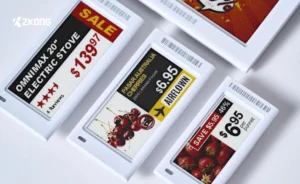
The smaller per-item strips, the daily-special inserts, and the nutrition-information cards at counter level are e-paper ESLs, typically 4.2″ to 11.6″ diagonal. These are battery-powered and refresh on the same chain-wide push that drives the LCD boards.
Drive-Thru Menu Boards Specifically

Drive-thru is where the calorie disclosure rule has its highest stakes, because 65% to 70% of QSR transactions go through the drive-thru in 2026 and the menu board is the customer’s only visible interaction with calorie information. Replacing a backlit printed drive-thru menu panel costs roughly $2,400 to $4,200 per location in print, shipping, and labor. A 200-location chain doing one major menu refresh per year and three minor ones is spending $1.4M to $2.5M annually on physical menu board changes.
An LCD-based drive-thru system at 65″ with the necessary outdoor-rated enclosure runs $7,500 to $11,000 per location for hardware and install, plus $180 to $240 per month for content management. The capex is higher; the ongoing change cost falls to nearly zero. Payback for a chain with frequent menu changes is typically 14 to 22 months.
The Real Cost of One Mismatch Event

FDA enforcement under 21 CFR 101.11 can result in warning letters, civil money penalties, and (rarely) injunctive action. The 2023 case referenced above settled at $112,000. Other public cases have ranged from $35,000 for a single-location violation to $480,000 for a multi-location chain with documented willful non-compliance. Beyond the federal penalty, several states (notably California and New York) have parallel state-level menu disclosure rules with their own enforcement, and class-action plaintiffs’ firms have begun bringing private actions where state consumer-protection statutes allow it. A single mismatch event at scale can run $100,000 in pure FDA penalty plus another $250,000 to $1.2M in associated state and private exposure.
Against that risk, the math for digital menu boards is straightforward: the upgrade pays for itself on the first avoided enforcement action even if the labor and printing savings were zero, which they are not.
Implementation Pattern for a 75-Location Chain
A typical fast-casual chain deployment Retail Digitals quoted in early 2026: 4 LCD menu boards per drive-thru-equipped location (3 drive-thru, 1 indoor counter), 8 to 14 e-paper ESLs per location for nutrition cards and counter-side menu strips, ZKong Cloud for content management, integration to the chain’s existing menu management system (typically Olo, Toast, or NCR). Total capex around $48,000 per location; 75 locations at $3.6M. Ongoing cloud and signage management at $42,000 per month chain-wide. Annual savings from eliminated print-and-ship cycles: approximately $1.8M to $2.4M.
What to Spec When You Start
Three things to pin down on day one: (1) outdoor brightness rating (3,000 nits minimum for drive-thru, full stop), (2) integration to your menu management system before you spec the displays, since the data flow is what makes the system actually solve the compliance problem, and (3) a content approval workflow that puts compliance counsel in the loop before any chain-wide push, because an instant push of a wrong calorie count is worse than a slow push of a right one.
For a deployment plan and capex model specific to your location count and drive-thru footprint, contact us. To estimate the payback against your current print-and-ship spend, the ROI calculator includes a restaurant-specific menu-board preset.
Sources & references
Related articles

Kamran Abdullayev
Sales Director, North America at Retail Digitals (ZKong USA), the United States distributor of ZKong electronic shelf labels. Based in New York City. Writes on US ESL deployment, regulatory compliance (AB 3214, FDA 21 CFR 101.11, METRC), and honest competitor comparison.