
Why most ESL pilots underdeliver
The pattern repeats: a chain commits to “let’s pilot ESLs,” buys 2,000 labels, deploys them across multiple departments in a single weekend, and three months later concludes “ESLs aren’t working for us.”
The technology was fine. The pilot was wrong. Specifically:
- Too many SKUs at once — couldn’t isolate workflow problems
- No baseline metrics — couldn’t prove savings
- No staff buy-in — clerks resisted because they weren’t consulted
- No clear “go/no-go” criteria for expansion
This playbook avoids those failure modes.
Phase 1: Pick the right pilot scope (Week 1)
Pick ONE department in ONE store. Specifically:
The right department
Choose the department with: (a) frequent price changes, (b) high SKU velocity, (c) clear shelf layout (not too many endcaps).
- Best: Dairy aisle (high turnover, dynamic pricing)
- Good: Frozen foods (freezer-rated test, focused SKU set)
- Good: Produce (price-by-weight, daily markdown)
- Avoid: Center-store grocery (slow-changing, less dramatic ROI)
- Avoid: Liquor (regulated pricing complications)
The right store
Pick a busy store, not your slowest. You want real operational stress to expose any workflow gaps.
The right SKU count
200-500 labels for the pilot department. Enough to be statistically meaningful, small enough to debug.
Phase 2: Establish baseline metrics (Week 2)
Before you install a single label, measure:
- Time spent on daily price updates in this department (have a clerk track for 1 week)
- Number of price errors caught at POS (week-by-week trailing 4 weeks)
- Customer service complaints related to shelf-vs-checkout pricing
- Labor cost: hourly rate × hours/week × 52 = annual baseline
- Paper supplies cost: printer rolls, ink, label stock used per week × 52
Have someone NOT involved in the project measure this. You want unbiased baseline numbers to compare against later.
Phase 3: Install + train (Week 3)

Order ESLs (200-500 for pilot dept). For most groceries, the right starting SKU mix is:
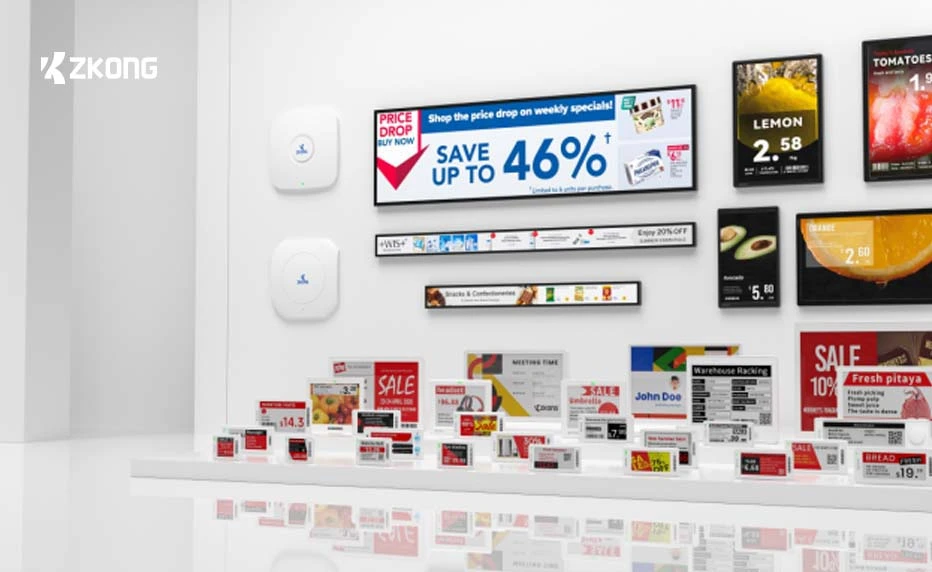
- Valley Series (1.5″-2.6″) for standard shelf labels
- Shield Series freezer variants for cold sections
- Arrow Series if you want to test shelf-edge bars on multi-product strips
Install (1-2 days)
Two staff can install 200-500 labels in one shift. Most ESLs ship with adhesive or rail-clip mounts. Install access points on the ceiling (1 per ~200 labels). Connect to your network.
Configure (1 day)
Map each label to its SKU in the cloud platform. Most platforms have a phone app for label-by-label assignment via NFC tap.
Train staff (4 hours total)
2 hours: floor staff on what ESLs are, how to flag a broken label, what NOT to do (don’t remove, don’t replace battery yourself).
2 hours: department manager on the cloud platform — how to push price updates, view audit logs, troubleshoot.
Phase 4: Run for 4 weeks, measure obsessively (Weeks 4-7)
Track the same metrics as your baseline:
- Time spent on daily price updates (now: should be near-zero)
- Price errors caught at POS for these SKUs (should drop to zero)
- Customer complaints (should drop to zero)
- Battery failures (should be zero — labels are new)
- Network reliability (should be 99%+ uptime)
Also track operational issues:
- Did clerks find any labels confusing or hard to read?
- Were there any SKUs that needed special handling?
- Did the cloud platform integrate cleanly with your ERP?
- Any Wifi / network gaps in the store?
Phase 5: Go/no-go decision (Week 8)
The decision criteria for chain-wide expansion:
GO if:
- Labor savings >15 hrs/week per pilot department
- Zero price errors caught at POS for pilot SKUs
- Battery failure rate <0.1% in pilot period
- Floor staff report neutral-to-positive (not actively resisting)
- ERP integration is stable
PAUSE and iterate if:
- Labor savings <5 hrs/week (your dept may not have been the right pilot)
- Network reliability <95%
- Floor staff actively avoiding (workflow needs redesign)
- Cloud platform crashed more than once
NO-GO if:
- ERP integration fundamentally broken
- Battery failures >1% in 8 weeks (vendor problem)
- Multiple labels physically broken (vendor problem)
If GO: deploy chain-wide, store-by-store, on a 4-6 week per-store cadence. Use the playbook from your pilot.
Talk to us if you want help scoping a pilot specific to your store layout. We’ve helped multiple chains start with one department and expand from there.
Want a personalized recommendation?
15 minutes on a screen-share — we look at your specific stores and recommend SKUs.
Related articles

Kamran Abdullayev
Sales Director, North America at Retail Digitals (ZKong USA), the United States distributor of ZKong electronic shelf labels. Based in New York City. Writes on US ESL deployment, regulatory compliance (AB 3214, FDA 21 CFR 101.11, METRC), and honest competitor comparison.