
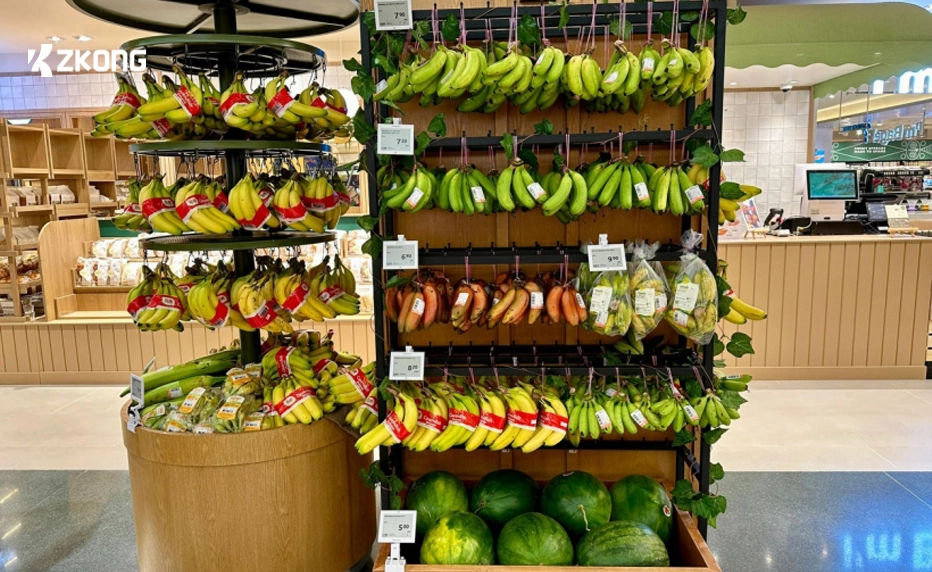
Why produce is the highest-ROI ESL category
Across grocery deployments we’ve scoped, the fresh produce section delivers the highest ROI per dollar of ESL hardware spent. Not because produce is bigger — produce is usually only 8-12% of total store SKUs — but because shrink in produce is the largest controllable line item on the store P&L, and ESLs directly attack it.
Industry benchmarks put fresh produce shrink at 8-15% of revenue at most US chains. A typical 50,000 sq ft grocery loses $200-400K per year on produce alone. A 30-50% reduction in that figure is genuinely transformative — and the mechanism is simple.
The mechanism: time-decay markdowns
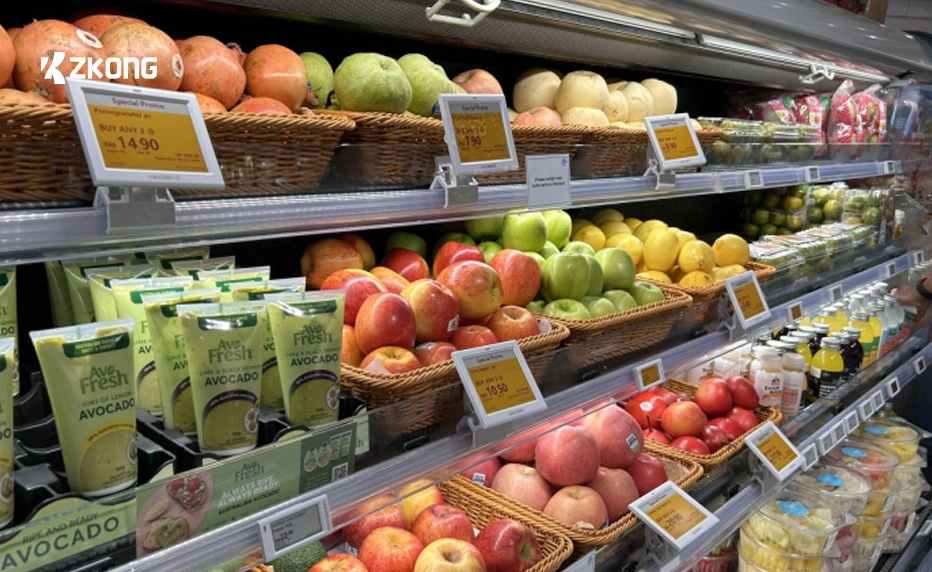
Paper price tags can’t change throughout the day. Whatever price you printed this morning is the price all day, until staff manually pulls and replaces it. So produce markdowns happen on a manager’s gut call — “that romaine looks tired, mark it down 30%” — usually too late, often too aggressively.
ESL platforms unlock rule-based, time-decay markdowns:
- Tagged-on date 5 days ago at 9 AM → 0% markdown
- 72 hours from tagged-on → 15% markdown automatically
- 96 hours from tagged-on → 30% markdown automatically
- End of day before code-out → 50% markdown, then to compost or donate
The price label updates automatically as the rule progresses. Customers see fresh markdowns throughout the day, not just at closing. Shrink-to-compost shrinks; shrink-to-discount-revenue grows.
The data feed that makes it work
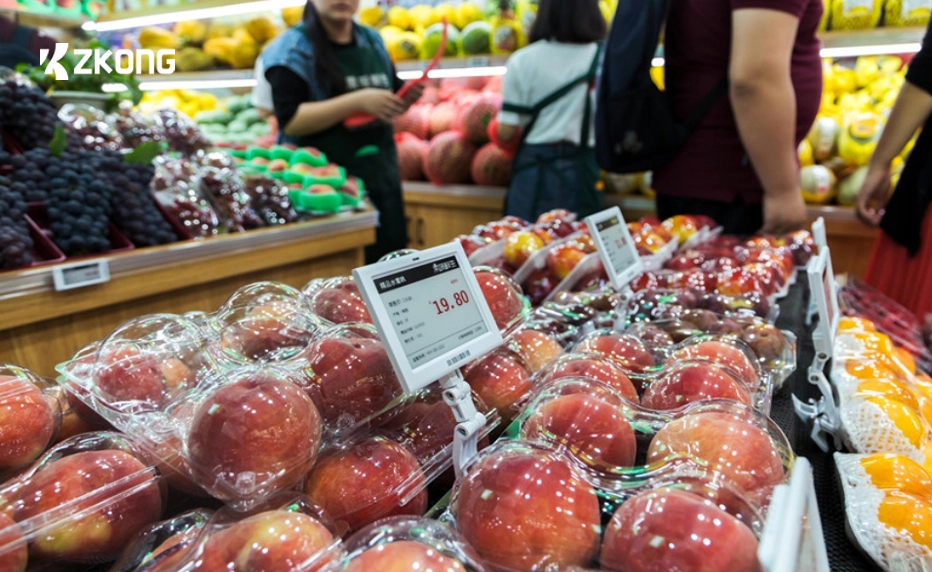
Three data points need to flow into the ESL platform per produce SKU:
- Tagged-on timestamp: when did this batch hit the floor? Captured at receiving or backroom prep.
- SKU-level markdown rule: different products decay differently. Berries vs apples vs bananas have different decay curves.
- Current sell price: standard POS feed, same as the rest of the store.
Most modern grocery ERPs (Microsoft Dynamics 365 F&O, NetSuite, Oracle Retail) capture tagged-on dates as part of receiving. If yours doesn’t, the cloud platform accepts manual tagged-on entry via the worker’s smartphone — scan the SKU, scan the label, timestamp captured.
Real numbers from a 30-store regional chain
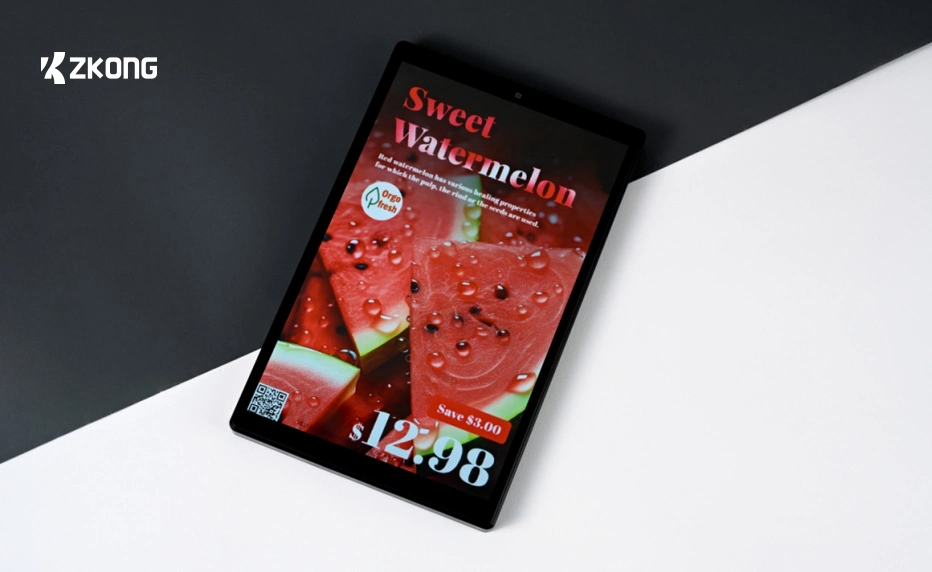
One Northeastern grocery chain we worked with implemented produce markdown ESLs across 30 stores in 2024. Pre-deployment baseline: 11.4% produce shrink across the chain, $4.2M annualized.
12 months post-deployment: 6.9% shrink, $2.55M annualized. Net reduction: $1.65M/year. Hardware + cloud cost: ~$650K one-time, ~$80K/year ongoing.
First-year savings: $1.65M. First-year all-in cost: $730K. Payback: roughly 5 months on the produce investment alone, before counting the labor reduction across the rest of the store.
The customer behavior shift
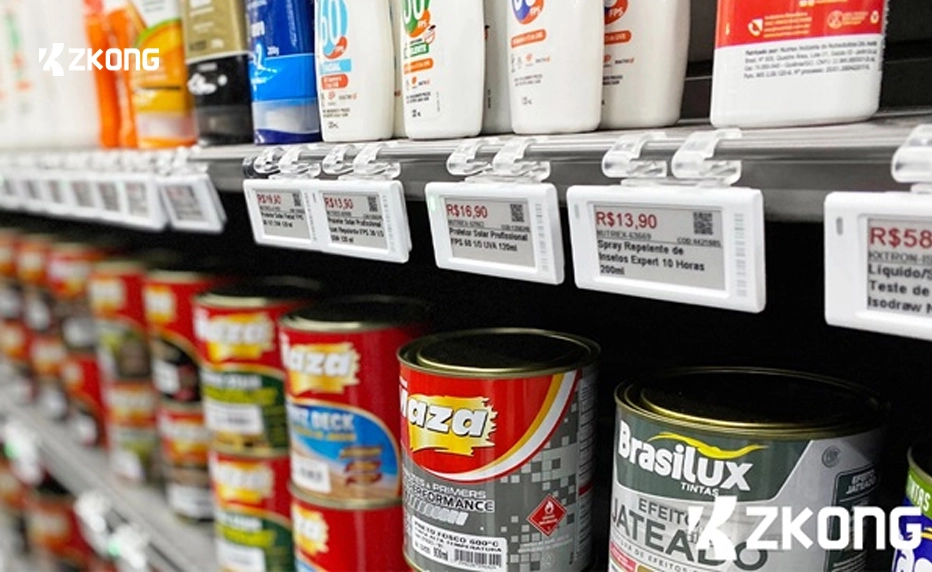
Worth noting: customers learn the rhythm. After 60-90 days, regulars start checking the produce section in the late afternoon for fresh markdowns. This isn’t a problem — it’s the system working. The customer who was already going to buy spinach now buys it at 4 PM at 25% off instead of bringing home spinach that wilts before they use it. Shrink that would have hit your P&L instead converts to revenue and customer loyalty.
Some chains worry about training customers to wait for markdowns and erode early-day margins. The data we’ve seen says this fear is overblown — only the most price-sensitive 10-15% of customers shift their shopping time. The rest still buy fresh produce on their normal schedule.
Hardware spec for produce
- 2.9″ BWRY minimum. Need room for product name, current price, markdown badge, and “freshness” indicator if you display one.
- Yellow accent (BWR or BWRY) is non-negotiable. Markdown signaling depends on visual contrast. Pure black-and-white doesn’t draw the eye.
- Freezer-rated for refrigerated produce coolers (-15°C operation). Cost adder of $2-4 per label, but standard tags fail in cold zones.
- NFC capability for fast tagged-on capture by produce staff.
Implementation sequence
Realistic timeline for a 10-store chain rolling out produce ESLs:
- Week 1-2: build markdown rules per SKU category (berries, apples, leafy greens, etc.) in the cloud platform.
- Week 3: pilot at one store with manual tagged-on entry via smartphone.
- Week 4-5: integrate ERP receiving feed if applicable.
- Week 6-7: validate markdown logic against actual decay curves; tune rules.
- Week 8-12: roll out to remaining stores at 1-2 per week.
By week 12, the entire chain is operating on dynamic markdown rules. By month 6, you have enough data to refine the rules per SKU based on what actually moves and what doesn’t.
What can go wrong
Three failure modes worth flagging:
- Tagged-on timestamps captured wrong: if receiving staff don’t actually scan when batches hit the floor, the markdown clock starts on the wrong day. Fix with simple training and audit checks in week 4-5.
- Markdown rules too aggressive: giving away 30% margin at 48 hours when produce would still sell at full price. Tune by category — berries decay fast, apples don’t.
- Customer confusion about the markdown badge: if your ESL template shows “WAS $X NOW $Y” without explaining why, some customers wonder if the product is bad. Add a small “FRESHER PRICING” or “END-OF-DAY VALUE” badge to normalize the practice.
Running produce shrink above 8%?
30-minute call to scope dynamic markdown rules against your specific SKU mix and ERP. We’ll model expected shrink reduction with no commitment.
Sources & references
Related articles


Kamran Abdullayev
Sales Director, North America at Retail Digitals (ZKong USA), the United States distributor of ZKong electronic shelf labels. Based in New York City. Writes on US ESL deployment, regulatory compliance (AB 3214, FDA 21 CFR 101.11, METRC), and honest competitor comparison.